Friday, May 17, 2013

On Short-Term Missions

          I must begin by confessing I've never been on a mission trip to a foreign country or even to another state (unless one counts choir tours with a Christian college).  However, I have supported various long-term missionaries over the years and have done service work in my hometowns with the Rescue Mission, Goodwill, Habitat for Humanity, retirement homes, my churches, and personal relationships.  The times I’ve had opportunities to go abroad for short-term missions work, I’ve debated the merit of my going and have always chosen not to; many seemed more like vacations or cultural education tours with a little teaching, painting, or babysitting thrown in.  I felt the travel money could be better spent in service to those in needwhether near or far.   I also suspected (rightly or wrongly, I’ll never know) that such a trip would do little to benefit my faith long-term and even less to benefit the people of that country either spiritually or materially.  Despite these thoughts, I know that short-term missions can benefit both the participants and the recipientsbut whether they do or do not is up to the mission planners, as well as to each potential mission-goer, who should prayerfully determine whether or not to go in the first place and how to behave when there.
          Plenty of other Christians have similarly debated whether short-term missions are truly useful and whether we ought to prioritize missions closer to home.  I recently came across some rather good articles on the former subject.  Their messages seem to agree that mission work succeeds only when participants keep a godly perspective and strive to not create a burden on the local recipients (following Paul’s example in 2 Cor. 11:9, 1 Thes. 2:9).  This means mission participants do their best to use the locals’ language, to follow the local culture (1 Cor. 9:19-22), to inquire after and help with the locals’ needs (rather than telling locals how they will “help”), and to use the participants’ resources for food, water, shelter, etc.  Participants must also be careful to help the locals become independent (via the mentoring of local spiritual leaders, permanent fixtures like water wells, general education and job training, entrepreneur support, medical care, and psychological counseling) rather than dependent (via spiritual dependence on temporary visits of foreign pastors, handouts of money that give people incentive to beg instead of work, donations of goods that hurt local businesses, and the creation or maintenance of unused buildings).  It also seems to me that missions are most successful when participants both tell the Good News AND interact with and help the locals; telling without helping convinces few people of God’s love and the value of belief, and helping without the Good News gives the Holy Spirit no opportunity to convict and save souls.  Finally, mission participants need to approach locals with a loving attitude: respectful, not superior; listening, not commanding; gracious, not rude; and cheerful, not complaining.  In this way, we can truly be good ambassadors of Christ.


If you’re interested in hearing more specific advice “from the horse’s mouth” (i.e. people who’ve actually done short-term missions), check out these links:


Three articles from The Gospel Coalition tell the history of the boom in short-term missions, problems with short-term missions, and ways to improve short-term missions.

Readers, what are your thoughts on the subject?

Thursday, May 9, 2013

On Mothers

As Mother’s Day approaches, it seems natural to consider mothers’ contributions to society--and to us, personally.  Mothers reading this may be thinking, “Yer darned right!” or “About time!”  However, I’m too aware that other readers, even if they’d never dream of saying it aloud, might be thinking more along the lines, “Do we really need another ode to mothers?  Haven’t we read enough sappy, idealized effusions of gratitude?  Sure, mother are great and we wouldn’t be here without them, but enough’s enough!”  
To them, I would respond, “So, if you thank a person once, you never need do it again?”  Sure, some “odes” come off a bit too strong or fluffy, and thanks given to other people’s mothers may not mean as much as thanks to mothers we know, but I would caution readers against ever taking anyone (mothers, fathers, teachers, construction workers--whoever) for granted.  Mothers in particular seem to get a lot of negative feedback--from their kids who had to wait ten minutes to be picked up from school; from every Tom, Dick, and Harry who likes to put in their two cents: “if those were my children...”; as well as from Freudian psychologists who blame parents for every perceived abnormality in their adult children.  Negativity even comes from the mothers themselves, who, like many women--mothers or not--tend to put burdens on themselves to be perfect and acceptable to society and/or God--yet who can attain perfection in this Fallen form?  They’re doomed to failure.  Thus, mothers need positive feedback where it’s due--not just to help them maintain a healthy self-image, but also because, if we think about it properly, they usually deserve praise and thanks more frequently than we give it.
Furthermore, what’s wrong with repetitious or belated thanks?  Sometimes we’re struck anew with gratitude for a particular kindness and feel it bears repeating months or years later.  (“I’m so glad you encouraged my education.”)  Other times our gratitude is late in coming--it may require hindsight to bring it to light, or even the experience of children of our own.  (“Thanks for not strangling me during my Terrible Twos.”)  A national holiday helps remind us to do what we ought to be doing all along.  It’s only a pity that we need the reminder at all.


Carole Denton and Laura Coon

             To the two mothers I’ve been blessed with: thanks for raising my husband and me.  Thank you for wiping our noses and our bums--for feeding us, clothing us, transporting us, and nursing us through illness. Thank you for sacrificing all the time you could have spent on your own pursuits to be there for us, to cheer for us, and to hug us.  Thank you for loving us despite being occasionally--okay, sometimes more than occasionally--displeased with our behavior.  Thank you for encouraging our education, introducing us to new experiences, and allowing us opportunities to explore music and sports and the arts.  Thank you for your patience and continuous efforts to curb our willfulness, our selfishness, and our tempers. Thank you for teaching us (sometimes by example) that it's okay to make mistakes, and that we should take responsibility for them.  Thanks for training us to value what’s good and godly, even if we don’t always behave as well as we know we ought.  Thank you for praying for us every day.  Thank you for teaching us to love others who may not seem very lovable.  And finally--most importantly--thanks for giving us your example of following Jesus and for encouraging us to follow and love Him, too.

Wednesday, May 1, 2013

On a Vile Experience with Cockroaches

Some years agoduring summer, as I recallI reached incautiously into our cabinet and immediately leapt back with a screech; I had found what every hygienic-minded housewife hates: a cockroach.  And where there is one, there are sure to be more. 
            Like many females, I’ve always been a bit squeamish about bugs that weren’t roly-polies, ladybugs, or daddy-longlegs.  Okay, more than a bit squeamishbut ever since seeing loathsome pictures of them as a child, cockroaches have ranked only one step below my nemesis, spiders.  This disgust increased to nausea in high school after witnessing numerous large cockroaches in a certain house in Indianaand disregarding politeness, I’d thereafter refused to eat any food that had been inside the house or to even step inside if I could avoid it.  On another occasion one evening in a South Carolina city, I’d spotted a cockroach as long as my hand skitter across a sidewalk.  *shudder*  Though the insects invading my kitchen were of a much smaller variety than those in more eastern states, these were definitely some version of the species—not a run-of-the-mill beetle.  Thus, the reader can imagine my horror upon discovering such...things in my own house.  My skin still crawls at the thought of them and their proximity to me.
            I spent that memorable afternoon cautiously pulling each bottle, bag, box, and canister off our shelves, killing what beetles I could find, and freely expressing my revulsion with many shrieks and shuddering withdrawals, for no one else was home to witness my reactions nor to rescue me from this duty which my disgust compelled me to execute immediately.  I even foolishly tried to caulk the cracks between the shelves and the back of the cabinet.  It was all I could think of to keep them out, but even if I had figured out how to get the goop out of the tube (it had dried up, we found), Joel informed me upon his return that it wouldn’t have stopped the bugs from chewing right through it.  After Joel corrected my misapprehension about caulking, he left to fetch some cockroach poison—brown gunk that we squirted in a few places we thought the roaches were likely to venture.  I went to bed that night with ears alert for the slightest rustle that would indicate the disgusting critters were creeping toward our bedroom in search of revenge. However, to my great relief, the only roaches we found after that were dead ones, and we’ve never had another invasion since.  
After that incident, disgusted with the trouble I’d had getting at the bugs around all our little spice bottles, and disturbed by the idea of them crawling over or even into our containers of food, I made a few changes.  First, while I had everything out, I cleaned the shelves thoroughly, removed the ragged plastic covering on the bottom of one of the shelves and gave it a fresh coat of paint.  I then moved the soup cans from their plastic bin under my makeshift counter/cutting board into the pantry, put the spices into the soup’s former drawer, and on the spice’s old shelf, set boxes of nuts, Splenda, and sugar free jello (the latter of which Joel still hasn’t eaten these many years later... how long do those last?).  I then made two trips to Walmart in which I bought far too many plastic containers in an attempt to find ones that fit both the shelves and the contents I hoped to place in them.  Some I returned, some I gave away to Goodwill, and some I managed to use.  I stored my lesser-used boxes of tea in one such large plastic bin, poured the bagged sugar and the boxed macaroni into others, tucked individual tea bags into a tin, and generally organized the contents of the shelves.  Thus, though the infestation had been a horrible experience, it at least motivated me to greater storage efficiency, and that, at least, I have not regretted.

Thursday, April 25, 2013

On Irony


Unlike the term “satire” discussed in a previous post, the term “irony” seems more often used and even less correctly understood.  Its use (or misuse) is not limited to academic circles or literature classes; whether a statement or situation is or is not ironic has been a frequent matter of debate in online comments and in verbal conversation.  Even I have to pause and evaluate whether the declared “ironic” situation is truly an example of irony.  Part of the difficulty lies in that not everyone agrees on its definitionor, one might say, certain kinds of irony depend on one’s perception.  The following, therefore, merely sets forth my own understanding of the term.


People commonly say such things as “How ironic that it would rain just when I’m ready to walk the dog.”  However, that’s not irony; that’s an annoying coincidence.  
“It’s ironic that this politician embezzled.”  Um... sorry.  Still “no”unless some unstated aspect of the context makes it so, such as his previously speaking against embezzlement, and even then it's questionableI mean, we're talking about a politician.
“A car crashing into a ‘drive safely’ signnow, that’s ironic!”  Finally, yes!  In this case, we see situational irony between an expected outcome (that people would drive more safely because of the sign) and the real outcome (a car crash despiteand more ironically, intothe sign).  In a similar way, Shelly’s poem “Ozymandias” demonstrates situational irony with the visual juxtaposition in its final lines:

And on the pedestal these words appear:
"My name is OZYMANDIAS, King of Kings."
Look on my works ye Mighty, and despair!
No thing beside remains. Round the decay
Of that Colossal Wreck, boundless and bare,
The lone and level sands stretch far away.

The following images likewise show the same kind of irony:

http://izismile.com/2012/05/10/irony_alert_part_2_18_pics.html

Aside from situational irony, other forms include dramatic, verbal, and Socratic.  Dramatic irony appears solely in fiction (plays, films, literature), for its irony is understood by an audience but not by the characters, such as in Romeo and Juliet when most characters believe and behave as though Juliet has died while the audience knows otherwise.  Verbal irony is mild sarcasm in which the words express the opposite of their literal meaning, such as “What lovely weather” said in regard to a hailstorm.  Finally, in Socratic irony, a questioner pretends ignorance to expose his interlocutor's folly, such as used by... well, you can guess.  
In general terms, then, irony is “a reversal of expectations” (Matthew Inman, theoatmeal.com).  Of course, this definition of irony causes some debate, for someone might say, "I expected Jim to lose that race, but he won it insteadis that ironic?"  Not quite.  The speaker's guess was merely incorrector one might say Jim exceeded expectations rather that reversing them.  Furthermore, it fails to be ironic because the juxtaposition between the twoexpectation and realityis neither striking nor proximate.  Finally, for some morbid reason, negative reversals seem more ironic than positive ones: simply consider the relative perception of irony in "We'll be fine" spoken just before a tragedy and "We're gonna die!" shouted just before a rescue.
            The line between error and irony is extra fuzzy since one person’s expectationsor strength of said expectationsmay differ from another’s.  Thus, I prefer the definition that irony is any contradiction between an action or statement, and its context.  (I just recalledC.S. Lewis wrote in The Screwtape Letters that the Joke Proper "turns on sudden perception of incongruity."  Rather similar to irony, eh?)  Even then, however, one may argue that a contradiction between assumption and reality exists in un-ironic circumstances, such as coincidences, unfortunate scenarios, and human errors.  Alas!
            Well, even if the term's still unclearly defined, at least you now have a couple working definitions you can use to defend your position in a dispute over the presence of irony.


To view Inman’s humorous (but unfortunately crass) explanation of irony, click the following link: http://theoatmeal.com/comics/irony.

Wednesday, April 24, 2013

On Satire

           I worked with a student yesterday whose paper dealt with a certain author’s various literary devices, one of which was satire.  As I read the paragraphs dealing with that “technique,” the words didn’t quite ring true, but I found myself unable to articulate what satire is or how she could improve her use of the term.  I looked up satire in the dictionary and even called over my coworker, but we were equally at a loss.  As a literature major, I felt chagrined.  At length, I agreed with my co-worker that the paragraph seemed well-written, supported by quotes from the book and paraphrases from sources.  The student’s use of the term “satire” still seemed off, but I feebly suggested she add what foible each example was a satire of, and we moved on.
            A niggling discontent with my ignorance prompted me (after completing other necessary chores at work) to research satire.  Up, Wikipedia!  Down, ignorance!  And now, dear readers, you shall benefit from my lesson:


            First, satire is not a technique; rather, it is a genre along with comedy, tragedy, romance and the rest.  As such, it has its own particular style and purpose: namely, satire employs such techniques as irony, sarcasm, parody, exaggeration, caricature, juxtaposition, mockery, double meanings, and so on to critique an aspect of society--politics, religion, human rights, manners, traditions, and so on.  The author seeks to expose human folly and to shame individuals and society into improvement, so in essence, satire uses wit as social criticism.  Thus can one easily distinguish satire from its techniques or from non satirical teasing, dark humor, and other forms of mockery and juxtaposition, for satire always addresses core issues related to the subject’s ideas, morals, conduct, traditions, or social position--and most notably, its address judges the subject and draws toward it not sympathy, but criticism (and, one hopes, beneficial change).
Literary satires include well-known titles such as Candide, Animal Farm, and The Screwtape Letters.  Many film spoofs are also a form of satire, as are the articles and videos from the “news” website The Onion.  Even funnies like Doonesbury and Beetle Bailey, and certain story arcs in Terry Pratchet’s Discworld series count as satires.  Satirical works such as these range from the mild and humorous (e.g. The Rape of the Lock) to the intensely serious (e.g. Lord of the Flies) to even the grotesque, tragic, or offensive (e.g. Gargantua and Pantagruel).
Though satirists hope to motivate social improvement--and some like Charles Dickens do--in some cases, their works prompt primarily negative reactions because they can, understandably, come across as unpleasantly critical and even insulting.  Occasionally, satirists make purposefully inflammatory works.  For instance, the savage verses of an ancient Greek poet named Hipponax allegedly caused one of his opponents to hang himself [“Hipponax,” Wikipedia].  However, even with milder satire, readers may take offense easily if they have a personal connection to the subject the work addresses: Consider when, in 2005, satirical Muhammad cartoons printed in the Danish newspaper Jyllands-Posten sparked violent worldwide protests.  Problems may also occur if readers take a sarcastic work literally.  For example, A Modest Proposal is indeed offensive if one thinks Jonathan Swift earnestly supports cannibalism as a means to reduce poverty.
Due to satire’s potential to inflame readers, most totalitarian countries prohibit it (along with less-divisive forms of free speech), and even some organizations in “free speech” countries like the U.S. have banned particular works from their libraries, schools, and so forth (such as the book The Adventures of Huckleberry Finn).  However, we cannot discount their potential for good: Dickens’ social satires were widely enjoyed and likely paved the way for various social reforms during and after his time.  More recently, Doonesbury satirized a county law in Florida “requiring minorities to have a passcard in the area; the law was soon repealed with an act nicknamed the Doonesbury Act” (“Satire: Contemporary Satire,” Wikipedia).  

            As Wikipedia observes, satires can relieve or even resolve social tension, and they “provide the keenest insights into a group's collective psyche, reveal its deepest values and tastes, and the society's structures of power.”  With such a testimony to the genre's lofty role in society, I'm sure I shall never again mistake satire for a mere technique.


Wednesday, April 10, 2013

On Tornados


When I was seven, I slept through a tornado.  
That’s not as unusual as it sounds; my room was already in the basement, and the tornado didn’t come near our house, so my parents saw no reason to wake me.  Furthermore, the neighborhood’s tornado siren always sounds faint inside the house, and the storm itself didn’t make any more noise than a usual storm.  When I was told about the tornado the next morning, in my child-like way, I felt impressed by my “feat”--it seemed like a bragging point.  It doesn’t now, of course; sleeping during a tornado due to ignorance is not particularly laudable or even strange.  However, it’s an indication of my upbringing, which has led me to perceive tornados as an interesting natural phenomenon to be cautious of but not to fear.  
I’m well aware that many out-of-staters and Kansans alike find tornados terribly frightening.  I presumably acquired my ambivalence by observing and imitating the calm, prudent attitudes of my parents and teachers, who I’m sure first exposed me to tornados through tornado drills during preschool and elementary school.  Mom has also reported that I watched The Wizard of Oz repeatedly as a five-year-old.  Naturally, I now have no memory of doing so and no notion of what I thought of Hollywood’s tornado, nor its relation to me or my state.  Still,  these unremembered events surely affected the way I perceived that tornado in second grade.
    Tornado and fire drills were both mandatory at Pleasant Hill Elementary, and in later grades, I vaguely remember the space we used for the former--a long, featureless concrete room embedded in the hill for which our school was named.  We accessed it through the kindergarten or one of the first grade classrooms, which took up the outer part of the walk-out basement.  There we were made to sit in rows.  To the teachers standing over us as monitors, we must have looked like a bunch of funny turtles, bent over our crossed legs and covering our necks with our hands.
    The next tornado I recall struck while I was in summer daycare at Temple Beth Shalom (in cooperation with Topeka’s YWCA).  I might have been eight or nine.  We were herded toward the basement, and rumor quickly spread through the ranks that this was a real tornado rather than a drill.  The steps we descended paused at a landing before turning and continuing down, and I was one of several kids who paused to gape out the rain-speckled window there, hoping to see the tornado.  Our caretakers scolded us and made us continue downstairs.  I remember feeling irritated with them, certain that our watching wasn’t nearly as dangerous as they supposed.
In sixth grade, our class toured Washburn University.  The only part of that excursion I remember, however, was the room with aftermath photos of the devastating 1960s tornado that tore through Washburn U. and other parts of Topeka.  I remember feeling amazed by the amount of destruction, and I remember--piecemeal--our teacher’s recollection of hiding below their stairs during that event and how she felt when she and her family emerged.
That was also the year we frequently went outside to work on a compost project for our science lessons.  I recall sitting on the hill while this student or that dug through the compost and made observations.  One of those days, some of us were distracted, studying some thick clouds amassing, which we speculated were thunderheads.  Before we’d finished our work with the compost, we heard the tornado sirens begin, though the sun still shone in part of the sky.  We returned inside with a mixture of reluctance and excitement.  
The movie Twister came out in 1996, and my family watched it some time after it came out on video.  Unlike the main characters, I was a cautious child and fond of my comforts, not inclined to put myself in danger or get wet however interesting it might be to study something like a tornado, but I did once run into a downpour with wild delight to investigate a new stream that had appeared in our yard parallel to the creek a dozen yards away.  My dad was furious when I didn’t come back immediately when he called.  Even though there wasn’t a tornado, lightning was another very real danger which may have passed through the water to me or may have struck one of the giant cottonwoods by our creek and sheared off a huge branch above my head, which it has done in the past (sheared off a branch, that is--not over my head).
When the tornado sirens sound now when I’m at home, I unplug my laptop in case of a lightning strike and spend a few moments examining the sky from the screen door.  Although our basement is a creepy, spider-filled place where I don’t like to linger doing laundry too long, eventually, I’ll grab the flashlight and a book, and go sit on the basement steps (it’s not possible to sit under them, and there’s no way I’m venturing into the poorly-lit, unclean other half of the basement where I might hide in what was to be a closet before mold made the basement uninhabitable).  When multiple people are present, we may sit on top of the dryer or on a folding chair brought down from the kitchen.  I may go up now and then to watch the rain or hail and to check for twisting clouds.  When Joel’s present, he watches the radar for us; when he’s not, I simply take my ease as best I can and wait for the sirens to stop, indicating it’s safe to ascend to ground level.
I wouldn’t say I have a cavalier attitude about tornados; I’m well aware of their dangers--Topeka’s 1960s tornado might have been before my lifetime, but Greensburg’s certainly isn’t.  Whether foolish or not, I don’t mind my little risky glimpses of nature’s power, knowing it is just a fraction of the power its Creator has at His disposal.  It awes and thrills me--though like anyone, I’d prefer the tornados chew up unused land instead of homes and crops and lives, but despite that, I’d rather live in unpredictable tornado country than in hurricane country, where those storms’ destruction and flooding are often more wide-spread than that left behind by our smaller, more powerful twisters.  I pray I’ll never have reason to regret this preference.

Wednesday, March 27, 2013

On the Custom of Holding Doors


Though society has no law or moral requirement regarding holding doors open for others, somewhere along the line it’s become a curious custom in our part of the world--a courtesy which men originally performed for women but which anyone might now perform for succeeding persons.  (Naturally, this applies to hinged doors--particularly ones that swing closed automatically--rather than to hanging, sliding, or revolving doors.)  People who practice door holding rarely reflect on why or how we do it, yet like other customs or traditions, whether a “thank you” after being helped or exchanging presents at Christmas, someone who breaks the custom risks annoying other persons.  However, unless done with the purpose of giving offense, an omission of this custom is hardly sufficient reason to break peace between persons, nor is it a moral misdeed in the category of stealing or even calling someone a rude name.  However, it’s still such an ingrained part of our culture that a person who wishes to be courteous ought to learn and comply with the custom.
I can only wonder about when or where men first began holding doors for ladies.  The underlying motive for all rules of etiquette is selfless consideration for others, so I imagine that at first, men--likely in a patriarchal European society--performed the act as a natural and occasional courtesy toward women, which over time became generally perceived--and then ingrained--in our culture as good manners.  It may even have been codified in tomes on etiquette, possibly in Europe during the 17- or 1800s (or so I would guess using my knowledge of history--which admittedly isn’t as extensive as I might wish).  Perhaps someone else can tell me if my guess is correct or if this custom had (or has) parallels in non-European-based cultures.
Whenever and wherever it began, gentlemen (whom I name thus for their genteel actions rather than landownership) certainly continued to hold doors for women into the mid-1900s.  Considering the weight of some of those old-style doors, I’m sure many women appreciated this act of consideration.  It may well have made them feel pampered and appreciated.  However, this perspective began to change during the feminist (or femi-nazi) movement in the ‘60s and ‘70s when some women decided the gesture implied their arms were weak or that they were subordinate to the male holding the door.  Even today, a few women get offended when a man holds a door for her as if she were incapable of doing it herself.  I believe such overly defensive women are rare, but perhaps due to the influence of such thoughts, many men no longer see a particular need to hold doors for women.  The custom itself persists, but today’s door holders are more often the first person of either gender to reach the door.  
I can’t recall ever hearing a thorough explanation of the etiquette of modern door holding; parents or other role models comment on it now and again, but one must generally pick up the nuances through observation and trial-and-error: One learns to calculate the speed of an approaching person to determine whether one should wait with the door open, or continue walking and let it close.  One must similarly decide whether, in a mass of humanity entering, exiting, or both, one should step aside and hold the door for everyone or simply support the door long enough for the nearest person to hold it as he or she passes through.  “Thanks” may be a sign one’s gotten it right; “excuse me” or “sorry to make you wait” may be a sign one needs to refine one’s actions.

I have here compiled twenty “rules” I’ve observed--some common-sensical and some requiring a little more thought.  Readers, share your own “rules” in the comments if you think I’ve missed or erred with one:


When to hold a door, and for whom:

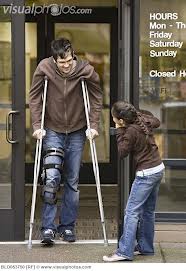
  1. One should always give preference to a person less mobile than oneself or whose hands are occupied--whether by a child, objects, crutches, a wheelchair, etc.--since that person would find grasping the door or pressing an automatic-open button awkward or inconvenient.  If one is in a position to hold the door for such a person, even if one does not intend to pass through it oneself, one should do so--and if passing through oneself, one should not balk at speeding up or even around the person, or at waiting longer than usual by the door to be sure of giving aid.


  1. If neither party is particularly encumbered, and assuming a second person is relatively near, etiquette suggests that men hold doors for women and that younger persons hold doors for older persons--each with the motive of showing respect, and each more important in formal settings than in informal. 

  1. When the inner space is smaller or more full of people, such as in a subway or restroom, the person on the outside should always hold the door for the one on the inside--or at least politely stand aside--to allow the one inside to exit before the one outside enters.

  1. These considerations being moot, the first person to reach a door should hold it for the next person or persons.

  1. If a door would have time to fall and remain completely closed for a second or more before the other person arrives at it, one may let it fall and walk on without giving offense or particular inconvenience.  Persisting to hold the door while the other person is at such a distance may distress the individual one intends to help, for it makes that person self-conscious of his or her own speed and aware of inconveniencing the door holder.


How to hold a door:

  1. Unless an awkward situation requires it, one should avoid holding a door so that others must pass under one’s armpit.

  1. One who opens a door by pulling and holds the door for persons going either direction ought to stand behind the door, or if that’s not possible, beside its open edge so the passage remains clear.  


  1. One who opens a door by pushing may hold the door for someone following by taking a step or two inside and supporting the door from a position “in the way” until the follower can stretch a hand out and take the door’s weight, at which point both may move forward.  Note that this method would not suit a formal setting.

  1. One who opens a door by pushing and is obliged to hold it--for a large party following, for an oncoming person by dint of arriving first, for someone with no free hands to perform the office, or for someone in a formal setting--should walk through and turn to stand behind or beside the door.  This way, others passing through need not support the door, themselves, nor be forced to awkwardly squeeze by the door holder’s body.

  1. If persons on opposite sides of a transparent door see each other approach at the same time, and if one is a man and the other a woman, traditionally the woman will slow or pause and let the man reach the door first to hold it for her.  My own logic, however, suggests that since the person on the “pull” side of the door can hold it most conveniently for both individuals, this person had best do the honors regardless of gender.

  1. When one notices a person holding a door for a large flux of individuals without finding an appropriate time to let go, one should offer to take over for a while so that person may also pass through or continue on his or her way. 

  1. Even when a door is held for one individual, anyone--but particularly a man for a woman--may politely offer to take the position of a current door-holder with words such as, “Here, let me get that for you,” “Allow me,” “Ladies first,” or “Please, after you.” 

  1. One offering to hold a door for a current door holder may only reach out to perform the office while speaking if reasonably sure the offer will be accepted; if unsure of the offer’s reception, one had better wait until receiving an acceptance so as to avoid seeming offensively forward or forceful.  Either way, one should take the door without touching the current door holder, obstructing his or her way, or subjecting him or her to close quarters with one’s armpit.  If, instead, the offer is refused, one may say something like, “I don’t mind”--once--but if refused a second time, one should acquiesce and keep the peace.

How to respond to door-holding:

  1. The one benefiting from the clear passage ought always to thank the door holder--or at least acknowledge the person’s consideration with a smile and possibly a nod.  


  1. One ought never to consider someone’s offer to hold a door rude when made in a gallant manner--whether the one offering would replace a man, woman, or child, or whether he would replace an able or less able person.  He intends to be considerate, which deserves thanks rather than censure.  However, one may acceptably refuse with words such as, “Thanks, but I’m fine” or “No, please--after you.”

  1. If an elderly or less agile passerby takes offense at one’s attempt to hold a door for him or her, one should give a simple apology rather than argue or grovel.

  1. In essence, it’s impolite to fuss about who holds the door, to make a showy scene of being polite, or to get in the way of others.


How to respond after a door-related error:

  1. If passersby fail to acknowledged a door holder’s service, or if someone fails to apologize for a door-related error, one should maintain social harmony by ignoring the rudeness or omission rather than offering correction; only the relation of a child, student, or close friend entitles one to give the other a kindly phrased rebuke for such a relatively minor discourtesy.  Similarly, the recipient of a door-related error should accept a sincere apology immediately.

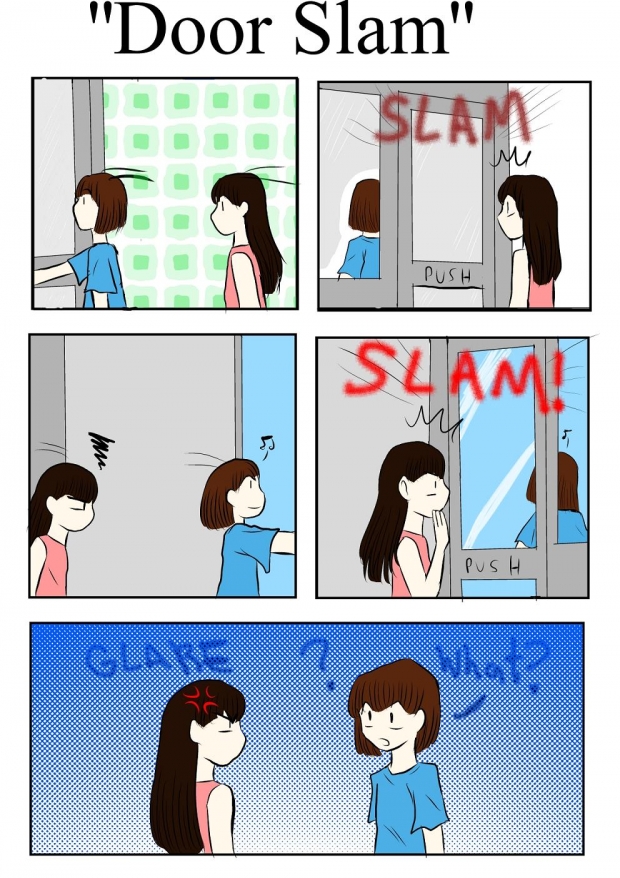
  1. One customarily offers a brief apology after realizing one let a door begin to close upon an unnoticed person who follows closely behind; it’s quite unpleasant for that second person to nearly walk into the edge of a door he expected to remain open, or to have said door close in his face (which, culturally, implies rejection or intentional disrespect). 

http://media-fancomics.theotaku.com/743000-20110729135110.jpg
http://how.to-draw.co.uk/?s=slam%20door
 
  1. One customarily excuses oneself or apologizes upon surprising someone formerly hidden on the other side of a door one has just opened.  An apology is especially necessary if that door knocked into the other person.


The golden rule for door holding and other acts of etiquette--“Do what least inconveniences others.”