Wednesday, March 27, 2013

On the Custom of Holding Doors


Though society has no law or moral requirement regarding holding doors open for others, somewhere along the line it’s become a curious custom in our part of the world--a courtesy which men originally performed for women but which anyone might now perform for succeeding persons.  (Naturally, this applies to hinged doors--particularly ones that swing closed automatically--rather than to hanging, sliding, or revolving doors.)  People who practice door holding rarely reflect on why or how we do it, yet like other customs or traditions, whether a “thank you” after being helped or exchanging presents at Christmas, someone who breaks the custom risks annoying other persons.  However, unless done with the purpose of giving offense, an omission of this custom is hardly sufficient reason to break peace between persons, nor is it a moral misdeed in the category of stealing or even calling someone a rude name.  However, it’s still such an ingrained part of our culture that a person who wishes to be courteous ought to learn and comply with the custom.
I can only wonder about when or where men first began holding doors for ladies.  The underlying motive for all rules of etiquette is selfless consideration for others, so I imagine that at first, men--likely in a patriarchal European society--performed the act as a natural and occasional courtesy toward women, which over time became generally perceived--and then ingrained--in our culture as good manners.  It may even have been codified in tomes on etiquette, possibly in Europe during the 17- or 1800s (or so I would guess using my knowledge of history--which admittedly isn’t as extensive as I might wish).  Perhaps someone else can tell me if my guess is correct or if this custom had (or has) parallels in non-European-based cultures.
Whenever and wherever it began, gentlemen (whom I name thus for their genteel actions rather than landownership) certainly continued to hold doors for women into the mid-1900s.  Considering the weight of some of those old-style doors, I’m sure many women appreciated this act of consideration.  It may well have made them feel pampered and appreciated.  However, this perspective began to change during the feminist (or femi-nazi) movement in the ‘60s and ‘70s when some women decided the gesture implied their arms were weak or that they were subordinate to the male holding the door.  Even today, a few women get offended when a man holds a door for her as if she were incapable of doing it herself.  I believe such overly defensive women are rare, but perhaps due to the influence of such thoughts, many men no longer see a particular need to hold doors for women.  The custom itself persists, but today’s door holders are more often the first person of either gender to reach the door.  
I can’t recall ever hearing a thorough explanation of the etiquette of modern door holding; parents or other role models comment on it now and again, but one must generally pick up the nuances through observation and trial-and-error: One learns to calculate the speed of an approaching person to determine whether one should wait with the door open, or continue walking and let it close.  One must similarly decide whether, in a mass of humanity entering, exiting, or both, one should step aside and hold the door for everyone or simply support the door long enough for the nearest person to hold it as he or she passes through.  “Thanks” may be a sign one’s gotten it right; “excuse me” or “sorry to make you wait” may be a sign one needs to refine one’s actions.

I have here compiled twenty “rules” I’ve observed--some common-sensical and some requiring a little more thought.  Readers, share your own “rules” in the comments if you think I’ve missed or erred with one:


When to hold a door, and for whom:

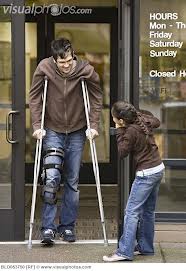
  1. One should always give preference to a person less mobile than oneself or whose hands are occupied--whether by a child, objects, crutches, a wheelchair, etc.--since that person would find grasping the door or pressing an automatic-open button awkward or inconvenient.  If one is in a position to hold the door for such a person, even if one does not intend to pass through it oneself, one should do so--and if passing through oneself, one should not balk at speeding up or even around the person, or at waiting longer than usual by the door to be sure of giving aid.


  1. If neither party is particularly encumbered, and assuming a second person is relatively near, etiquette suggests that men hold doors for women and that younger persons hold doors for older persons--each with the motive of showing respect, and each more important in formal settings than in informal. 

  1. When the inner space is smaller or more full of people, such as in a subway or restroom, the person on the outside should always hold the door for the one on the inside--or at least politely stand aside--to allow the one inside to exit before the one outside enters.

  1. These considerations being moot, the first person to reach a door should hold it for the next person or persons.

  1. If a door would have time to fall and remain completely closed for a second or more before the other person arrives at it, one may let it fall and walk on without giving offense or particular inconvenience.  Persisting to hold the door while the other person is at such a distance may distress the individual one intends to help, for it makes that person self-conscious of his or her own speed and aware of inconveniencing the door holder.


How to hold a door:

  1. Unless an awkward situation requires it, one should avoid holding a door so that others must pass under one’s armpit.

  1. One who opens a door by pulling and holds the door for persons going either direction ought to stand behind the door, or if that’s not possible, beside its open edge so the passage remains clear.  


  1. One who opens a door by pushing may hold the door for someone following by taking a step or two inside and supporting the door from a position “in the way” until the follower can stretch a hand out and take the door’s weight, at which point both may move forward.  Note that this method would not suit a formal setting.

  1. One who opens a door by pushing and is obliged to hold it--for a large party following, for an oncoming person by dint of arriving first, for someone with no free hands to perform the office, or for someone in a formal setting--should walk through and turn to stand behind or beside the door.  This way, others passing through need not support the door, themselves, nor be forced to awkwardly squeeze by the door holder’s body.

  1. If persons on opposite sides of a transparent door see each other approach at the same time, and if one is a man and the other a woman, traditionally the woman will slow or pause and let the man reach the door first to hold it for her.  My own logic, however, suggests that since the person on the “pull” side of the door can hold it most conveniently for both individuals, this person had best do the honors regardless of gender.

  1. When one notices a person holding a door for a large flux of individuals without finding an appropriate time to let go, one should offer to take over for a while so that person may also pass through or continue on his or her way. 

  1. Even when a door is held for one individual, anyone--but particularly a man for a woman--may politely offer to take the position of a current door-holder with words such as, “Here, let me get that for you,” “Allow me,” “Ladies first,” or “Please, after you.” 

  1. One offering to hold a door for a current door holder may only reach out to perform the office while speaking if reasonably sure the offer will be accepted; if unsure of the offer’s reception, one had better wait until receiving an acceptance so as to avoid seeming offensively forward or forceful.  Either way, one should take the door without touching the current door holder, obstructing his or her way, or subjecting him or her to close quarters with one’s armpit.  If, instead, the offer is refused, one may say something like, “I don’t mind”--once--but if refused a second time, one should acquiesce and keep the peace.

How to respond to door-holding:

  1. The one benefiting from the clear passage ought always to thank the door holder--or at least acknowledge the person’s consideration with a smile and possibly a nod.  


  1. One ought never to consider someone’s offer to hold a door rude when made in a gallant manner--whether the one offering would replace a man, woman, or child, or whether he would replace an able or less able person.  He intends to be considerate, which deserves thanks rather than censure.  However, one may acceptably refuse with words such as, “Thanks, but I’m fine” or “No, please--after you.”

  1. If an elderly or less agile passerby takes offense at one’s attempt to hold a door for him or her, one should give a simple apology rather than argue or grovel.

  1. In essence, it’s impolite to fuss about who holds the door, to make a showy scene of being polite, or to get in the way of others.


How to respond after a door-related error:

  1. If passersby fail to acknowledged a door holder’s service, or if someone fails to apologize for a door-related error, one should maintain social harmony by ignoring the rudeness or omission rather than offering correction; only the relation of a child, student, or close friend entitles one to give the other a kindly phrased rebuke for such a relatively minor discourtesy.  Similarly, the recipient of a door-related error should accept a sincere apology immediately.

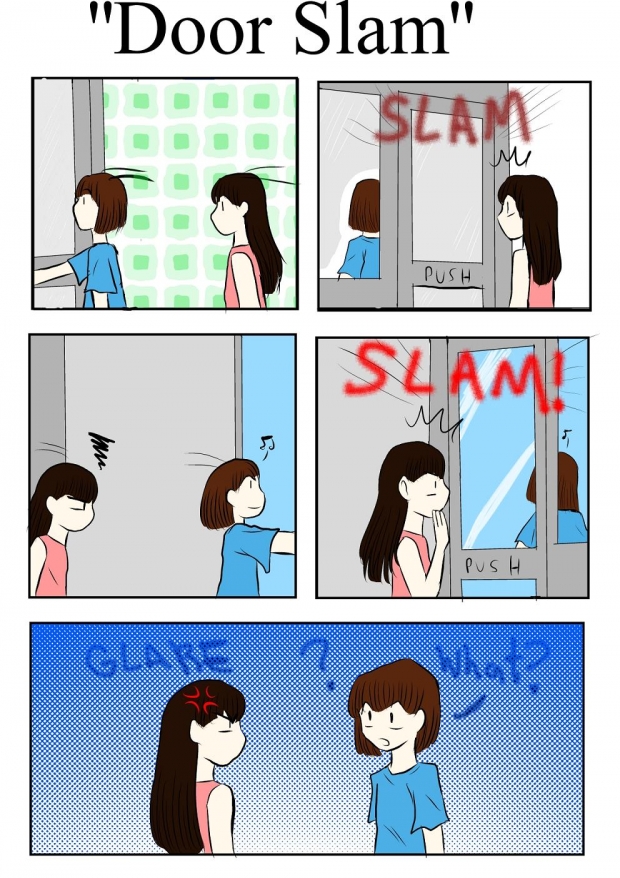
  1. One customarily offers a brief apology after realizing one let a door begin to close upon an unnoticed person who follows closely behind; it’s quite unpleasant for that second person to nearly walk into the edge of a door he expected to remain open, or to have said door close in his face (which, culturally, implies rejection or intentional disrespect). 
http://media-fancomics.theotaku.com/743000-20110729135110.jpg
http://how.to-draw.co.uk/?s=slam%20door
 
  1. One customarily excuses oneself or apologizes upon surprising someone formerly hidden on the other side of a door one has just opened.  An apology is especially necessary if that door knocked into the other person.


The golden rule for door holding and other acts of etiquette--“Do what least inconveniences others.”

Monday, March 18, 2013

On Adventures with Marzipan

Note: If you'd like to read this humorous anecdote without the cooking details, skip the blue text.
 
          For a couple months, I’ve kept a perpetual tab open in Firefox with a recipe for marzipan.  
          For a couple weeks, I’ve had two cans of almond paste sitting ready in my plastic kitchen drawers.  
          Finally, on Friday, I resolved to make the recipe, but to get ideas for shapes, I first watched a couple online videos in which two women (with delightful British accents) demonstrated how to form marzipan roses and animals.  I decided to start with the former. 
           Mentally prepared, I readied my kitchen space and began.  I found it relatively easy to mix the almond paste, powdered sugar, and corn syrup.  Once it formed into a proper ball, I separated a small portion of the light beige dough, and then encircled the rest in plastic wrap and stuck it in the fridge for safekeeping.   
           At that point, to continue following the recipe required that I flaunt the video’s advice against liquid food coloring.  I bit my lip and hoped it would turn out well.  A couple drops of red dye got me a nice pink shade, and a little more powdered sugar made up for any additional stickiness.  I rolled it out, only mildly inconvenienced by my long wooden rolling pin in the tight quarters of my kitchen.  
           Lacking a rose-petal-shaped cookie cutter (which looks like a one-inch-long tear drop), I cut approximate shapes out with a knife.  I had to then pinch the round edge to thin the marzipan to a petal-like thickness, so the jagged edges weren’t much of an issue.  The first petal wrapped around a small cone of marzipan.  The round portion of the tear-drop petal lay fractionally above the tip of the cone, and the petal’s sides overlapped just slightly.  A little delicate pinching adhered it to the cone, and a little more pinching around the tip curled one part of the marzipan petal outward.  Three more petals, one inside the next, wrapped around this first petal, again rising slightly above and curled outward.  I stopped there, with a bud, on my first try, deeming the final round of five a bit too unwieldy to manage at first.  I cut off the rose’s ugly “stem” and set both aside. 


           With my second effort, I attempted the layer of five, but by that point, I had to wet the tip of my finger and dab the drying round ends of the marzipan so they’d pinch and flatten properly.  Unfortunately, this made them so sticky they tore easily, and I had to constantly re-coat my fingers in powdered sugar, giving the petals an uneven coating of “snow.”  Still, I felt fairly pleased with the result, but with the third and fourth roses, it grew harder and harder to keep the balance between stickiness and dryness, and the petals grew harder and harder to peel off the cutting board, so I scraped the whole pink lot back into a ball, wrapped it in plastic, and banished it to the fridge.  The finished roses made their way into a Gladware container (whose lid I always fear I’ll tear when I try to pry it open) and followed in the wake of the marzipan dough balls.

           Now, Joel and I planned to entertain guests Monday night: Joel’s former college roommate, Andrew Wallace, and his fiancé, Sam, would be driving through the area.  They’d requested chicken pot pie, which I looked forward to making, and I envisioned a dessert of personal apple pies—a simple but somewhat time-consuming recipe I’d tried out a few weeks before.  I made sure to acquire all the ingredients, and with our guests in mind, I also decided to make more marzipan roses as an extra treat.  Thus, I set to work Sunday afternoon before our Easter choir practice.  I left the neutral-colored ball alone, but re-thawed and re-rolled the pink marzipan ball.  I managed perhaps six or seven more roses before the same problem forced me to reevaluate my plan. 
           I reformed the ball with a little water, then kneaded, rerolled, and flattened it.  Frustrated with the irregular results achieved by knife cutting, I tried using the small end of my melon baller to cut round petals.  It worked rather well, though I had to run powdered-sugar-coated fingers around the melon baller's lip between cuts to keep the marzipan dough from sticking inside it.  These round pieces seemed impractical to form a rose, and at any rate, roses were time-consuming.  Time was running out before practice, so I experimented with arranging the round pieces roughly in the shape of a violet.  The effect wasn’t as realistic as the roses, so I stopped after two and put the completed flowers back in the fridge.  I wasted a few minutes molding the remaining ball of pink marzipan into an animal head (using my own judgement rather than advice from the online videos).  No matter how I pinched and pushed it, I couldn't decide if it looked more like a cat, a pig, or a cow, so I mashed it back into a ball and returned it to the fridge, rewrapped in plastic.


           Today, after work and a visit to Aunt Margie, I arrived home at 3:30 pm ready to prepare our meal as planned.  I readied my work area and first prepared the dough for the pot pie's crust.  The first time I had made the dough—for a pumpkin pie—I’d successfully modified Betty Crocker’s recipe by adding about a tablespoon of sugar per batch.  This I did, wondering if perhaps it was too much for a savory dish, but trusting what I’d written in the past.  I split the dough in half, wrapped the one half that would become the pie’s top in plastic and stuck it in the fridge, a shelf above the unshaped balls of marzipan.  The other half I rolled out and laid beautifully in the pie pan.  After trimming the edges of the dough, I laid plastic over that, too, and set it aside.
           Next came the chicken.  I started cutting fat off the chicken thighs and then cutting the chicken into bits… and then cutting some more… and yet more.  Joel got home, took his shower, came out, and I was still cutting chicken.  I lamented internally that I hadn't cut it the night before.  I kept glancing at the clock, gauging my time, and put Joel to work setting the table and washing dishes.  While I stirred the still-heating gravy for the pot pie, I asked him to peel and chop the carrots.  Noticing his careful speed at the cutting board, however, I suggested we swap roles so that I might chop them in half the time. 
           Now sweaty from working over the stove and with a sore back from standing still so long, I was eager for a shower and change of clothes before our guests arrived.  I had a half hour in which to do so—then fifteen minutes—then ten.  In haste once all was ready, I dumped the peas, carrots, and drained chicken into the boiling gravy Joel had dutifully kept from burning, pulled the pie pan from the oven where the bottom crust had been partially pre-cooked, dumped the innards in the shell, and grabbed a tan ball of dough from the fridge—cursing my foolishness for keeping it in there where it had gotten hard in the cold. 
            By bearing heavily on my floured rolling pin, I managed to roll the dough out on my flour-coated cutting board, but it kept trying to tear at the edges.  I feared I had gotten the marzipan by mistake for a moment.  A tiny pinch tasted like flour rather than sugar—good.  I carefully laid it over the pie, cut the excess dough, and pinched the edges together.  The lot went in the over for thirty-five minutes while I went in the shower for about five—all the time I had until our guests were due to arrive.
           I emerged in record time with several minutes to spare; our guests were running late, having first gone to the wrong house.  I knew the apple dessert would be impossible to prepare in time, but if they didn’t mind a child's treat, I decided I'd bake the scraps from the pie pastry—spread with a thin layer of margarine and sprinkled with cinnamon and sugar. 
           Our guests arrived as I prepared the dessert.  We greeted Andrew and were introduced to Sam—a delightful young woman—and I set tea to brewing and finished our dessert, which they confirmed sounded great.
           A few minutes of talk later, the timer buzzed for the pot pie.  I opened the oven… and stared in horror at my pie's blackened top.  How could this have happened?  I felt horribly embarrassed and apologized to Sam, who entered and witnessed the catastrophe I drew out of the oven.  She kindly assured me that her family’s exploits with cooking were much the same, so she didn’t mind.  I still felt awful—and perplexed.  This had never happened to me before!  I’d made pies overly brown a time or two, but never charred black!  It had also spilled into the oven—what a mess that would be to clean!  I supposed I must have set the heat on 450 instead of 425, but even as I said it, I remembered turning the dial carefully between 400 and 450.
           I stuck the dessert in the slowly-cooling oven and set about cutting (unwisely early) into the liquid-y pie with my triangular metal pie spatula.  The top crust seemed unusually thin and loose, but fortunately the charring didn’t extend very deeply, and Andrew assured me the rest of it looked and smelled quite tasty.  However, it soon became clear that my utensil’s holes would be problematic when it came time to lift the pieces onto our plates.  The others gave various suggestions, including using a wider spatula.  With a self-mocking smile, I wordlessly drew out a soup ladle and pulled out bowls in which to place the soupy mess.  This worked quite well, and we sat down to enjoy the meal.
           I was somewhat relieved that my first bite did not taste charred—however, it tasted unusually sweet instead.  I apologized again, feeling not a little distressed—what must they think of my cooking abilities?—and speculated that I may have used too much sugar in the crust, which might be another reason why it had blackened... but I didn't quite believe it.  I also noted that chicken thighs were also naturally sweeter than the typical chicken breasts used in this dish, but again, I wasn't convinced it could turn the pie this sweet.  Andrew said he actually liked the sweetness.  Encouraged, I acknowledged the unintended—but admittedly not unpleasant result—with no further complaint, and we ate and talked steadily of old college professors.
           When the kitchen timer went off, at first I didn’t know what it was for.  I rose and displaced Andrew to turn it off, supposing aloud that I must have accidentally set it when I turned it off earlier.   It wasn't until I had moved past poor Andrew again toward my seat that I remembered the dessert.  I stumbled returning to the oven (as if I needed to be more embarrassed).  I slid on my trusty red oven mitt and opened the door—upon dark brown bits of matter.  
           Not again! my heart cried as I tried to pry the melty bits up… and then logic caught up with my initial emotion: Pie pastry did not bloat or melt like this when charred.  Despite its crusty appearance, it also scraped easily from the pan—too easily, for it scrunched like soggy bread.
           That’s when I realized what must have happened.  I opened the fridge.  Yes—there was the ball of pie pastry.  I laughed as I related what had happened: The dough I’d grabbed and rolled out for the top of our pie had been the neutral-colored marzipan!  The pinch I'd taste-tested had been full of flour from rolling it out!
           We found that the baked marzipan “dessert” tasted fairly good, but as it cooled, the sugar made it nearly impossible to scrape off the pan—the heat reacted with the sugar so that when it cooled, it formed a hard candy.  After getting only a third off the pan and onto Sam and Andrew’s plates, I was forced to soak the rest in water, giving it up as lost.  
           Our guests enjoyed the treat, peculiar and unintended though it was.  We joked about kitchen accidents becoming inventions, and I shared how I created my recipe for potato soup from a mix-up while making my first chicken pot pie.  This incident reminded me to pull out the marzipan roses so Andrew and Sam could experience what marzipan was supposed to look and taste like.  (Which, unfortunately, wasn't as tasty as the rounds of Mexican marzipan that I remember my dad giving us as kids, but it served its purpose.)  Thus, despite everything, the catastrophic meal still turned out well and was followed by a fun game of Castle Panic and then Carcassonne, accompanied by much laughter and conversation.

           The moral—every catastrophe has a silver lining, so don’t get too upset over it. 
           Another lesson—marzipan chicken pot pie tastes surprisingly good, though in the future, I recommend using less marzipan.  To prevent burning, add it in bits below some real pastry dough--or add the marzipan topping about eight minutes before the pie is to emerge. 
           A third lesson—if you bake marzipan, cook it at less than 400 degrees for less than 10 minutes (how much less will be a matter of experimentation), and scrape it onto wax paper immediately to avoid an inedible, rock-hard mess.

Tuesday, March 12, 2013

On Girl Genius: a Recommendation

        Back in college (seven years ago, now... whoa!), my dad sent me a link to a little online graphic novel called Girl Genius.  Considering it has become my favorite online graphic novel and that the related Agatha H novels are my favorite books, I confess myself surprised that I have not yet dedicated a post to them.
        This three-time Hugo Award-winning “gaslamp fantasy” (for those deprived of the experience) chronicles the adventures of a young woman named Agatha, who soon discovers she is the long-hidden heir to the renowned house of Heterodyne.  Her tale is set in a vaguely Victorian era.  I must say “vaguely” since it’s an alternate European history in which mad scientists and their mechanical and biological creations are distressingly (or fascinatingly?) common.  Those with this “Spark” of mad genius can bend the laws of physics, and the strongest (or most reckless) can lay waste to entire civilizations.  Agatha’s forebearers—all strong Sparks—were terrors of this sort.  However, her missing father and Uncle Barry redeemed the name of Heterodyne in their youth by becoming sparky heroes fighting for peace and safety throughout Europa (as the natives call it).  This newly-revealed heir must now contend with an array of people who want to use her, kill her, or—in at least two prominent cases—marry her.  At the same time, she begins to come into her powers and gains numerous allies, which include a warrior princess, a talking cat who happens to be a military genius, a sentient and morbidly sadistic castle, as well as a wide variety of minions and monsters.
        An ineffable "Something" in Phil and Kaja Foglio’s work engages my compassion for the characters and secures my rabid interest in their fates despite my typical disregard for Victorian-esque settings and zany plots—somehow, those elements actually work in this story's favor.  Even better, the writing appeals perfectly to my sense of humor.  (I'll post more on the humor later, I hope.)  I’ve consequently found the series effective therapy for all forms of depression and ennui.  This means I’ve read each novel at least three times and am beginning my fifth or sixth read through the online comic, the updates of which I still read faithfully three times a week.  Perhaps it's needless to say at this point, but I highly recommend my readers give it a try if they haven’t already.

Thursday, March 7, 2013

On Lists

During my childhood, Mom instilled in me the value of to-do lists, which has lasted all my life. They help me remember and prioritize my activities when I feel stressed, and I find it incredibly satisfying to cross items off once they’re complete.  Doing so is a sign I’ve eliminated one source of chaos in my life and have regained some measure of organization and control.  Unfortunately, I’ve noticed I also tend to use lists in my prose--or rather, to overuse them.
Excessive listing is a literary failing I must constantly resist or, failing that, revise to avoid or reduce.  Though this tendency stems from my desire for linguistic precision, even I am aware that a piece with list after list quickly becomes dull.  There’s a reason most people dislike reading the beginning and end of Numbers in the Old Testament!  (My daily devotion had me read Numbers, chapter 2 today--a coincidence I didn’t recall when I started this post.)
            Now, in a larger sense, what is an essay but a list of reasons and details in support of a thesis?  By the same token, what is a story but a list of events and actions and feelings?  Yet somehow, skilled writers keep such lists from resembling a dry recitation and maintain the thoroughness they provide: Writers connect them with transitions, intersperse them with narratives, and expand them with details; they vary the lists from words to sentences to phrases to paragraphs to clauses.  The result is a flowing, organized progression of thought that is more than its constituent parts.

Wednesday, March 6, 2013

On Perceptions of Food

Our opinions about food go beyond personal preferences for taste, smell, appearance, texture, and even sound (whether this includes the food’s name or the way it squelches between our teeth).  Culture also sways our perception of a food’s appropriateness to a season, meal, or our bodies.
How interesting that certain foods evoke certain seasons or seem “wrong” to various people when offered out of that season!  I suspect this perception arises in part from regional growing seasons and in part from historical times when produce had to be consumed during certain seasons before it spoiled.  Similarly, the lack of thermostats in temperate and frigid regions made warm foods preferable in winter and cool foods preferable in summer.  However, now that we have such achievements as quick transportation between northern and southern hemispheres, greenhouses, freezers, central heat, and AC, we can easily enjoy pumpkin pie in June and iced lemonade in January should we so desire them.  
Yet despite our technological advancements, some old-fashioned ideas about seasonality persist, catered to by producers and retailers who naturally must adjust their supply to profit from popular trends--and whose ads even contribute to the stereotypes.  Oddly, some of these stereotypes are grounded more in holiday traditions than in seasonal availability.  For instance, when I decided to make pfeffernusse some weeks ago, I found that Walmart only carries anise oil during Christmas time, but I know of no seasonal reason for this restriction.  This inconvenience means that cooks must stock up months in advance--or find a non-seasonal supplier on the internet--to obtain certain unseasonal ingredients.
Seasons aren’t the only mental restriction we place on food; we have similar ideas about meal-specific dishes.  Some people, for instance, feel a mild shock when they hear about others consuming pizza for breakfast or pancakes for supper.  (Joel and I enjoyed pumpkin pancakes for dinner not too long ago.  Pumpkin goes well with our Belgian pancake mix!)  We all have some cultural rationale for our conceptions: some people cannot bear the thought of heavy food or even a great quantity of light food on an empty stomach in the morning, while others prefer it to help them last through the day.  Others like lunch to be their biggest meal of the day, while others prefer a small salad or granola bar--either in an effort to diet or so they don’t grow sleepy during the workday.  Supper, in turn, is in some cultures the large family meal and a time for the cook to show off, while in other places, people eat a small, quick meal alone or in the car before their evening activities.
Likewise, culture and habit also affect our perceptions of desert--both timing and content.  Dessert cakes in some cultures are so dry and bland that most Americans with our sweet tooths would never consider them true desserts.  As another example, I remember feeling cheated as a kid when the long-awaited dessert turned out to be “just some fruit,” which at that time I considered more of a snack or appetizer.  This perception has changed as I’ve gotten older, and I now feel that canned peaches in particular make an excellent desert!
            I haven’t even begun to mention our ever-changing nutritional perceptions--affected by fad diets, media sensationalism, and new or competing research.  The “experts” continually debate whether certain foods are healthful or harmful and whether certain combinations are beneficial or hazardous.  This has left us with some very confused and irrational consumers, some of whom make certain restrictions or suggestions nearly a crusade.  However, I say leave it to the health boards to make dangerous foods illegal, and let people eat whatever they darn well please regardless of the season or meal time or others’ opinions about the food--I only recommend people partake moderate portions of a variety of (preferably unprocessed) items from each food group: whatever tastes delicious, gives energy, and causes no subsequent discomfort.


Joel prepares to eat an Asian-inspired meal back in May of 2011: 
nikumanju (meat buns), carrot kinpura, and edamame.

Thursday, February 28, 2013

On a Little "Guilty" Pleasure: Star Trek Voyager

I’ve been watching a lot of Star Trek: Voyager lately.  I’ve been rather addicted, in fact, opening Netflix for something to do as I eat dinner or to unwind before bed (typically a few hours longer than I intend).  I’ll often play spider solitaire while I watch to keep my hands busy (and off of food).  Fortuitously (or not), an unfinished game gives me an excuse to watch another episode, and an unfinished episode gives me an excuse to play another hand, and in this manner, I very enjoyably (if not very productively) pass many hours.


                Some may scoff at my choice of viewing material.  Shows like Castle, Once Upon a Time, and Downton Abbey are more popular, socially “acceptable” series to watch--and these three are, indeed, among my favorites.  Voyager, however, is lighter material for an evening’s entertainment and a pleasant break from reality and from mental exertion.  Another part of its charm is its familiarity and nostalgia; I watched these episodes with my family as a kid, and watching them again lends me an inclusive pleasure not unlike that of understanding an inside joke.  Sure, the show can be corny, predictable, and preachy about everything from evolution to individuality.  Despite that, it’s oddly satisfying.  The crew’s triumphs and happiness become my own.  I am also of the opinion that a little (mostly) wholesome diversion such as this provides (well, probably at less than my current binging rate) can be cathartic and encouraging.
I know others understand this feeling: In the Castle episode “The Final Frontier,” the team investigates a murder at a sci-fi convention--more specifically, on the set of an often-mocked space-faring show.  When Kate Beckett’s coworkers discover she’s a secret fan, they tease her mercilessly.  Later, when she and Castle are alone, talking after hitting a snag in the case, she says, “You’re right, okay?  It was a stupid show.  It was cheesy and melodramatic.  I mean, a handful of academy cadets on a training mission and suddenly the Earth is destroyed and they’re all that’s left of humanity?  I completely understand why you hated it. BUT, Castle, I also understand why people loved it... It was about leaving home for the first time--about searching for your identity and making a difference.  I loved dressing up like Lieutenant Chloe. She didn’t care what anybody thought about her--and I kinda did at that time.  I mean, she was a scientist and a warrior, and that was all in spite of the way she looked.  It was like I could be anything and I didn’t have to choose.  So don’t make fun--okay?” 
I believe the script writers hit that proverbial nail squarely on its proverbial head.  (So, there!)

Saturday, February 23, 2013

On the Deplorable Misuse of Commas

I recently “bought” a free Kindle book.  The characters and situation intrigued me, but I kept putting it down in frustration because it was rife with grammatical errors--misspellings, awkward wording, fragments, and run-ons.  In particular, the frequent lack of proper commas slowed my reading, created confusing sentences, and jarred me from the action, thus detracting from my overall enjoyment.  I was dismayed.  Such a great story!  Where was the author’s editor?  How did the author manage to publish it in that state!?  Oh, yes--by not charging anything.
I confess that I didn’t fully understand when to use commas until I became a tutor and had to teach others when to use them.  After studying them properly, I realized how essential they are for the readability of a text.  Yet more and more, I’ve seen an increase in the number of writers--from students to Amazon authors--who disregard their importance and willfully disdain to learn their rules.  As for why, the ease of releasing text messages, blogs, online novels, and so forth has inundated us with poorly edited language, so much that I suspect we’ve become inured to it.  We now find comma-related errors in everything from church bulletins to newsprint to bestselling books.  In my work as a tutor, I’ve even heard some students declare that correct grammar looks “wrong.”  (I could comment here on the state of public high school education, but it would sidetrack from my point.)  In short, the proper usage of commas in every medium has been going downhill, and I find it deplorable.
I am not keen to debate the respective merits of descriptive and prescriptive grammar here. On a topic such as this, however, one would do well to keep in mind these different perspectives: Descriptive grammar simply describes how people currently use a language, without saying whether it’s right or wrong.  Prescriptive grammar is the opposite--the collective “rules” of a language, devised by “experts” from current or previous grammatical trends and enforced by editors and teachers on both nonstandard dialects and succeeding generations.  
Any sensible person would agree that a certain amount of “prescription” is necessary in education for students to cultivate a common tongue and clear communication.  Still, a “living” language continually changes; we do not now write in the style of Chaucer or Shakespeare or Ben Franklin or Hawthorn, or even Mark Twain.  With language in constant flux, people will continually debate which changes should become part of our language’s prescriptive grammar, and which they should discourage from continued use.  For example, we’ve thankfully done away with the prescriptive rule about not splitting infinitives, which was misguidedly based on Latin rather than English grammar, and I wouldn’t be surprised if “they” will one day be accepted as the singular, neutral form of “he or she,” considering its frequent (currently "incorrect") use as such in both speech and writing.  
Now, what of commas?  From a descriptive point of view, for whatever reason, most modern writers do not use them consistently nor in accordance with the “rules.”  Shall we say, then, that prescriptive grammar should follow the majority and let some of the comma rules slide into oblivion?  Who decides which ones are unnecessary for clarity?  For as many cases in which a comma must be used to avoid confusion, other examples for the same rule may demonstrate that the sentence comes across clearly without one.  I, however, believe our current rules are valid and should be promoted as they are.
The uninitiated may not quite realize how, without proper commas, we are often forced to reread to capture the right meaning.  Upon sensing an error in our understanding, our eyes and mind dart back through the text, reinterpret the sentence, and continue on their way, rarely dwelling on the passage long enough to comprehend why they stumbled over the sentence the first time.  Other times, however, the confusion is so grave that we’re jolted unpleasantly out of the story and must study the sentence multiple times to guess at the author’s intended meaning.  The culprit may be poor wording or, just as often, a missing or misplaced comma.  For instance, “That night lights inside her apartment shone bright as day.”  “Night lights” at first seems like the subject of the sentence, but if so, “that” ought to read as “the” or “those,” so it’s surely incorrect.  A comma after night would clearly separate the setting (“that night”) from the subject (“lights”), helping the reader comprehend the sentence correctly the first time through.
Despite the likelihood of confusing readers, many authors insist on using their “natural grammar” in opposition to prescriptive rules and even logic.  For instance, many would rather place commas wherever they take a breath--even though a hasty or overly-careful reading may result in very peculiar pauses indeed.  (For instance, “Don, was tired.”)  Using a comma when a reader should breathe is useful advice for a fourth grader, perhaps, but terribly inaccurate and misleading for an older writer who is capable of a greater understanding and more consistent usage (assuming said writer does not suffer from dyslexia or any other number of issues that make writing more difficult than usual).  Continuing to follow such a flawed concept into adulthood strikes me as naive and presumptuous--an insistence on one’s own, untutored preference over what would be most convenient and efficient for the reader. 
One must understand that comma correctness is primarily necessary to prose.  Poetry is a different matter--in part because ambiguity is an artistic technique and writers may want the reader to dwell upon and reread the lines in various ways to find some profound meaning for themselves. Grammatical ambiguity in fiction, however, should serve only as a means for humor or as a plot complication between characters, never as a possible stumbling block for readers.  One might also make an exception for an intentional digression, though I can think of no suitable examples.  Furthermore, should an author wish to break a rule to achieve a literary effect, sense dictates that said author should first understand the rules and the possible consequences of breaking them.  The rest of the prose needs to state ideas clearly.  Using commas correctly will by no means diminish the author’s ability to write creatively or vividly and will likely enhance the piece by allowing the text to flow unnoticed below the action occurring in the reader's imagination.


I'll leave the particulars of various comma rules for another time.

Thursday, February 21, 2013

On Snow

(Or as Joel quipped... "On  sNOwTABLE  Days.")

My earliest memory involving snow occurred when I was less than five--I can mark the time since we were in my parents’ Toyota truck, which they later replaced with a car.  The family was likely on its way to church, and in the middle of the Topeka Boulevard bridge, we lost control and spun a complete 360.  After a few seconds, upon realizing we were all unharmed and facing the correct direction, we gratefully continued on our way, but the fear and excitement of that moment engraved that experience into my memory, though time has faded the details quite a bit.  There were other times, later, when Dad spun the car purposefully in a clear parking lot for our enjoyment.  My brother, Daniel, begged for such rides more than I, especially as I became old enough to recognize the danger in such stunts but not to recognize the sense and caution my dad used when choosing a safe spot and controlling the spin.
I recall some rather impressive drifts once after a snowfall during my elementary school years.  The snow lay thinly along the open ground--a few inches, perhaps, having been half shoveled by the obliging wind into drifts several feet deep.  We got a snow day from school, as I recall--granted by Mom if not the school board since she didn’t know when we’d next get to experience and enjoy such a deep snow.  My brother and I burrowed into the drifts pushed up against our row of pines, creating snow tunnels and a pseudo-igloo.  Our excitement spurred us to work past the painful cold, and by the time we’d accomplished the bulk of our plans and shown the product off to Mom, our little hands and knees were reddened with the warning signs of frostbite, and we were more than happy to retreat indoors for some cocoa and hot baths.
My childhood saw other accumulations of an inch one day, a few inches another--decent, at least, for sledding and snowmen and snow angels and snowball fights, but rarely enough to cancel school, much as I might wish it would.  Ice more than snow determined our days off.  Even so, I remember vividly a certain hill during my junior high bus ride that was dreadfully steep even when it wasn’t slippery, and on one memorable, snowy morning, the bus slid backward for several frightening seconds, nearly into the ditch.  Our bus driver’s skill, God’s protection, or more likely both kept the bus upright and everyone safe, and the driver’s third (or perhaps fourth) essay of the hill succeeded.
During college, the first decent snow signaled a few, ah--interesting--traditions that I did not take part in but heard quite a bit about.  Both genders knew they ought to avoid the other dorms during this time.  For the women of McCreery dorm, where I lived, that was the night for naked snow angels (so-named, though some girls went out in bathing suits and shoes, and all at least stayed wrapped in towels before and after they made their angels), which they attempted to make at night in the soccer field without getting caught and lectured by the police.  For the men of Campbell dorm, it was the night for the “running of the bulls”--the evening many of them streaked (yes, naked but for shoes and perhaps a scarf or hat) a circuit around Campbell hall.  We would hear the next day at mealtime all the interesting incidents of men falling in the snow or almost getting seen.  And, as our college was known for its students’ pranks, it wasn’t altogether unexpected if a dorm woke the next morning to find snow shoveled high before the front doors or another such trick.
As I’ve matured (and developed a dislike for the cold that outweighs my former pleasures of playing in the snow), I’ve come to enjoy snow more for its beauty than for its entertainment value, and, of course, have learned to be wary of it while driving.  I cannot forget the destructive ice storm during the early spring of 2008--the beautiful crystalline ornaments on every outdoor surface and the numerous branches and power lines brought down by their weight.  
A couple years later, again during a spring snow, Joel and I slid into a shallow ditch on our way to Clearwater.  We were quite terse with each other as we tried to problem-solve our way out of it and eventually had to back up many yards to find a place where we could get back on the road.  Thankfully, the only harm from the experience fell on our egos.  By morning, we’d gotten perhaps six inches, and the Coon boys--Joel, Jon, and their dad, Dave--determined it to be a grand day to make an igloo.  We all pitched in to pack snow into plastic containers, upend them in position, and caulk them with more snow.  The result was taller than ideal, and the entry didn’t descend lower than the inside floor to trap the heat inside, but it was an igloo.  The three boys, with the addition of their cousin Nathan, ate a dinner of pizza inside, and Jon slept the whole night there on a cot (which was hard to maneuver inside).  Unfortunately, the poorly shape didn’t retain the heat properly, so it was a cold night for him.


Now we sit snugly in our little home as snow continues to bury the world outside.  I cannot remember ever seeing such a steady snowfall and deep accumulation.  
My first glance outside yesterday morning was greeted by the withered lawn, barren trees, and dry porch, yet tiny flakes had begun to dust the sidewalk by the time I left for work, so I swiftly changed my sneakers for boots in anticipation.  I had to brush snow off the back of the car, but my windshield wipers took care of the front without trouble.  
My desk at work gave me a fine vantage point from which to periodically note the snow’s steady descent.  The absence of a strong wind made it more pleasant outside, but I was glad when work gave me an excuse to not fetch the mail.  The college issued the alert that the campus would close at 3 pm, but I left at 2:30 pm at the end of my shift.  A half inch of snow had accumulated since the plow had last cleared the sidewalk, and I had to step over slushy black water at the edges of the street.  The heavy coat of snow on my car brushed off easily, but flakes continued to fall as I drove carefully home.  Joel was there when I arrived--he had returned safely from his surveying job in McPherson at 1 pm--so I had him fetch me the shovel while I was still bundled up.  Since I hadn’t been able to enjoy my customary walk to and from work, I got my exercise for the day scraping our front stoop and sidewalk clear.  I always regret the need to shovel since it inevitably ruins the smooth, pristine beauty of the snowscape, and this was no exception, as I had no way of avoiding the grass, leaves, and dirt clods hidden at the corners of the the sidewalk, which were then strewn in piles to this side and that upon the formerly pure whiteness.
When I came indoors, I checked the back porch, but the snow looked pristine, and we assumed the alley cats we usually fed would stay in their run-down garage rather than brave the thick snow.  However, I later peered out and spotted kitty footprints walking up the sidewalk to the back porch and away.  Noticing their empty bowl was masked by snow, I shoveled the porch and the walk and filled the kitty bowl, but the cats had apparently decided against venturing out, and hours later, it lay hidden, uneaten, under an even thicker layer of crystallized water.  
Not unexpectedly, the college announced the campus’ closure for the next day, a much-desired holiday for nearly everyone.  The weather that evening made a great day for Joel’s pork & ramen stir fry, the board game Dominion, and a new book--and so we concluded the day. 
The snow, however, has not concluded.   It has continued to fall in everything from languid flurries to speedy, nearly invisible specks to slower, fluffy, thicky-falling flakes that seem the epitome of the ideal Christmas snow.  By my recent measurement, it now lays 10 1/2 inches deep on every unsheltered surface.  Joel’s employers declared today’s work optional; fieldwork would be impossible, and only a little work could be done in the office, so he decided not to bother digging out his car.  Though my back's not happy that I shoveled yesterday, if I hadn't, we wouldn't have been able to shove our front door open this morning--and even that, I didn't bother trying past a half foot since the snow lays so thickly.  Later, though, mindful of the guilt I'd feel if another cat braved its way through the snow looking for food and found none, I squeezed myself out the back door and cleared the porch, scooping most of the snow out of the still-full food bowl.  I also took that opportunity to measure the snow in an area unaffected by my shoveling.  
Aside from that labor, I have determined to use this delightful holiday to accomplish one of the many enjoyable tasks my daily weariness has forced me to set aside, and as motivation to get past writer’s block, I have not let myself go through my usual morning webcomics until I've written and posted a worthy or interesting thought.  This task now complete--I hope to the reader’s enjoyment--I will now continue to enjoy this day of rest with Joel, with other writing projects, perhaps with the piano, and with many other long-delayed delights.